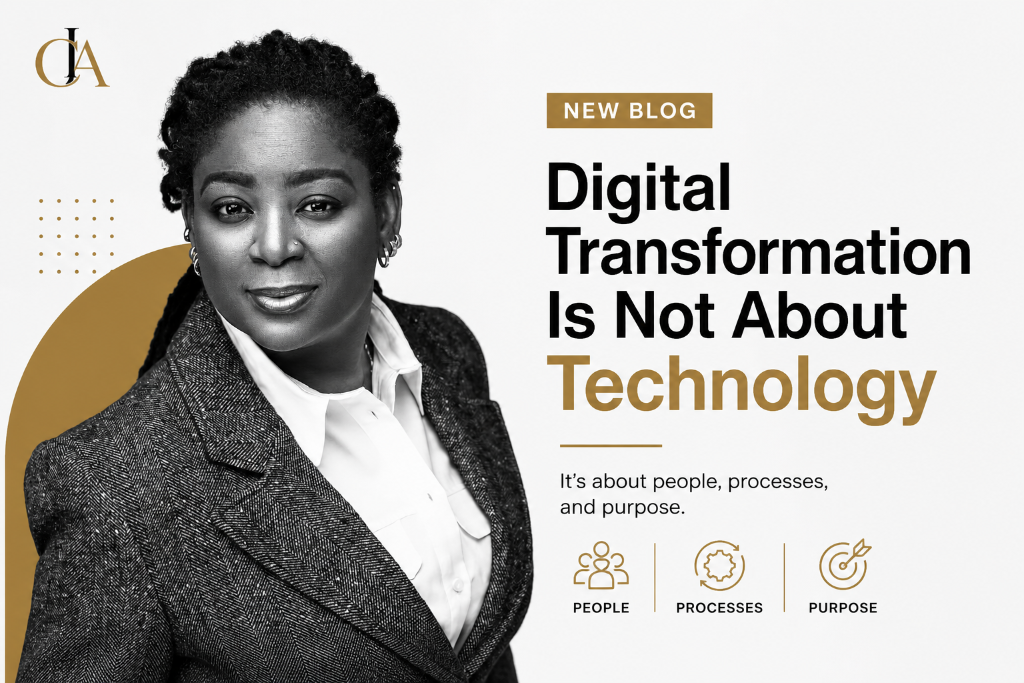
Digital Transformation Is Not About Technology
A Marketing Perspective on What Actually Drives Impact
Executive Insight
Most organisations approach digital transformation as a technology upgrade. New tools, platforms, dashboards, automation.
But from a marketing standpoint, that approach misses the point entirely.
Digital transformation is not about the tools you adopt; it's about how effectively you create, deliver, and capture value in a digital-first world.
1. The Real Shift: From Tools to Value Creation
Technology is an enabler, not the transformation itself.
From a marketing lens, true digital transformation means:
- Moving from campaign-based thinking → continuous customer engagement
- Shifting from intuition → data-informed decision making
- Evolving from brand broadcasting → value-driven conversations
👉 The question is no longer:
"What tools do we need?"
👉 The real question is:
"How do we create better customer experiences at scale?"
2. Why Most Digital Transformation Efforts Fail
From experience across brands and SMEs, failure usually comes down to three gaps:
❌ 1. Technology-Led Strategy
Businesses invest in tools before defining:
- Customer journey gaps
- Brand positioning
- Value proposition
Result: Expensive systems, minimal impact.
❌ 2. Disconnected Customer Experience
Marketing, sales, and operations operate in silos.
- Marketing generates leads
- Sales struggles to convert
- Customer experience breaks post-purchase
Result: Leakage across the funnel.
❌ 3. No Behavioural Change
Teams continue working the same way, just with new tools.
Result: Digital transformation becomes digital decoration.
3. What Digital Transformation Means for Marketing
A marketing-led transformation focuses on three core pillars:
1. Customer-Centricity (Not Channel-Centricity)
Modern marketing is not about:
- Social media
- Paid ads
It's about customer journeys across touchpoints.
Key shifts:
- From campaigns → lifecycle marketing
- From audience segments → individual behaviours
- From reach → relevance
2. Data as a Strategic Asset
Most SMEs collect data. Few actually use it.
Transformation means:
- Turning data into insight
- Turning insight into action
- Turning action into growth
Practical applications:
- Personalised messaging
- Smarter targeting
- Better retention strategies
3. Agility in Execution
Digital-first brands win because they move faster.
Marketing transformation requires:
- Shorter testing cycles
- Rapid experimentation
- Continuous optimisation
Example: Instead of one big campaign per quarter → Run weekly micro-tests across messaging, creatives, and channels.
4. The Marketing Transformation Framework
To make this practical, here's a simple structure:
Step 1: Define Customer Truth
- Who is your customer really?
- What problem are you solving?
- Where are the friction points?
Step 2: Map the Customer Journey
Identify:
- Awareness gaps
- Conversion barriers
- Retention weaknesses
Step 3: Align Technology to Strategy
Only introduce tools that:
- Solve a clear problem
- Improve efficiency
- Enhance experience
Step 4: Build Feedback Loops
- Track performance continuously
- Optimise based on real behaviour
- Close the gap between insight and execution
5. What This Looks Like for SMEs
For small and medium-sized businesses, digital transformation doesn't require massive budgets.
It requires clarity and focus.
High-impact moves:
- Implement a simple CRM to track leads properly
- Use email automation for nurturing (not just broadcasting)
- Analyse customer drop-off points and fix them
- Prioritise retention over constant acquisition
6. The Competitive Advantage
The brands that win are not the ones with the most tools.
They are the ones that:
- Understand their customers deeply
- Move quickly based on insight
- Deliver consistent, meaningful experiences
Final Thought
Digital transformation is not a technology project.
It is a marketing, business, and mindset transformation.
Because at its core:
Technology doesn't transform businesses.
Better decisions, better experiences, and better execution do.
Key Takeaways
- Digital transformation is about customer value, not tools
- Marketing plays a central role in driving transformation success
- Data, agility, and customer experience are the real differentiators
- SMEs can achieve transformation through focused, practical steps